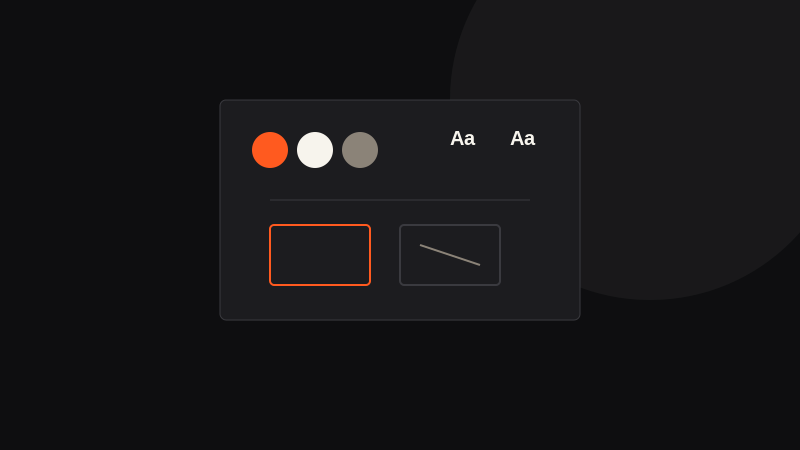
More than a simple reference document
A set of brand guidelines gathers all the visual rules of your brand: exact colours (hexadecimal or Pantone codes), approved typefaces, correct and incorrect uses of the logo, and the minimum space to keep around it. It is not just an aesthetic document, it is a real working tool.
Who brand guidelines are really for
- For yourself, to stay consistent in your future creations.
- For your colleagues or employees, who produce visual content without having to ask you for approval each time.
- For your providers (printer, web developer, community manager), so that they respect your identity without mistakes.
Have a logo or visual identity project?
See pricingWhat happens without brand guidelines
Without a reference document, every new creation relies on the intuition of the person making it. Over time, variations accumulate: a slightly different colour here, a replacement typeface there. This gradual drift dilutes your brand recognition, without anyone noticing straight away.
The contents of complete brand guidelines
Serious guidelines generally include the logo versions, the colour palette with its exact codes, the primary and secondary typefaces, the spacing rules, and examples of correct and incorrect uses to avoid any misinterpretation.
A concrete example of what changes day to day
Imagine a company that entrusts a social media post to an external community manager, then the update of its website to a developer, and the printing of flyers to a local print shop. Without brand guidelines, each of these three providers guesses on their own which colours and typefaces to use, and the results end up diverging. With guidelines handed over beforehand, everyone applies exactly the same rules, with no extra back-and-forth needed to clarify the point.
An investment that pays for itself quickly
For a small business just starting out, brand guidelines may seem unnecessary. But as soon as your business grows, or you work with other people on your communication, they become a considerable saving of time and consistency: that is why they are included in my most complete packages.
Brand guidelines and business growth
The more a company grows, the more people handle its visual identity: new employees, successive providers, business partners. Guidelines handed to each newcomer on arrival save you from re-explaining the same rules verbally every time, with the risk of forgetting or approximation that this involves.
If you want to move from theory to practice, see how I build a visual identity and brand guidelines: packages, contents and prices displayed.
Which guidelines for which size of business?
Brand guidelines don't need to be forty pages long. Their scope depends on the number of people who use them and the variety of materials:
- The minimal kit (one page). The logo and its versions, the colours with their codes, two typefaces. Enough for a freelancer or a very small business.
- Standard guidelines (a few pages). They add logo usage rules, examples of materials and what not to do. Useful as soon as several people or providers produce documents.
- Extended guidelines. They add principles for layout, illustration and tone. Relevant for an organisation with several departments or external partners.
In my packages, a concise usage guide is included in the Pro package and the complete guidelines in the Prestige package. The details are on the visual identity and brand guidelines page. Before paying for a brand book, check that the size of your business justifies it.
Questions to ask yourself before ordering brand guidelines
- How many people handle my identity today, and tomorrow?
- How many different materials (website, social networks, print, packaging)?
- Which external providers need written rules?
- What lifespan is the identity aiming for: a test or the long term?
For more advice on developing your brand, see the best tips for improving your brand.
Frequently asked questions about brand guidelines
Are brand guidelines required as soon as you have a logo?
No, they become relevant mainly when several materials or several people are involved in the brand's visual communication. A logo alone can be enough at the very start of a business.
Can you create your own brand guidelines yourself?
It's possible for the basics (colours, typefaces), but setting out clear usage rules and anticipating special cases generally takes real design work to be genuinely useful over time.
What do minimal brand guidelines contain?
The logo and its versions, the colours with their codes, two typefaces: one page is enough for a freelancer or a very small business.
When should you move to more complete guidelines?
When several people or service providers produce documents, or when the organisation has several departments or external partners.
A designer's perspective
I often see companies rediscover the usefulness of guidelines at the worst possible moment: when three different providers have each interpreted their brand colours in their own way, and everything has to be harmonised after the fact. An easy problem to avoid, if it is anticipated.
Brand guidelines are not a document you consult for pleasure: they are a tool that spares you dozens of small, approximate decisions made in isolation by different people.
In summary
Brand guidelines are a working tool, not just an aesthetic document: they serve you, your colleagues and your providers, and prevent the gradual drift of colours and typefaces. Their scope should stay proportionate: one page is enough for a freelancer, a few pages as soon as several people produce documents.