What Canva does well
Let's be honest: Canva is not a bad tool, far from it. For everyday communication needs — social media posts, presentations, flyers — it offers an excellent balance of simplicity and results. Its intuitive editor lets anyone produce a clean visual in a few minutes, with no design skills at all.
Where the tool shows its limits, specifically for a logo
A logo isn't a visual like any other: it has to work at every size, on every material, for years. That is precisely where Canva runs into its most concrete limits:
- No real vector file on the free plan — only PNG or JPG. The result: the logo loses sharpness as soon as it is enlarged (banner, sign, packaging)
- Non-exclusive templates — any free account can use the same template as you. The risk of ending up with a logo similar to another company's is real, not theoretical
- Limited graphic control — customisation happens through sliders and pre-built blocks, not through precise vector drawing work
- No built-in strategic thinking — the tool helps you assemble elements, not build an identity from a brand's activity, values and target audience
What the professionals themselves say
One observation comes up almost unanimously among graphic designers and agencies: Canva is rarely used to deliver a logo to a paying client. The reasons given are always the same: no precise vector control, difficulty handing over usable source files to another designer, and an originality that is inherently limited by the shared template system.
Even graphic designers who use Canva every day for other needs are clear on this point: the tool replaces neither real graphic design work nor brand strategy thinking. It lets you roll out an identity that already exists (through imported brand kits), not build one from scratch.
Who Canva remains relevant for
Canva has real uses: quickly testing a direction before formalising a brief, producing secondary communication materials once the identity is defined, or helping out in an emergency for a one-off, non-critical need. Using Canva isn't the problem — the problem is asking it to do a job it was never designed for.
The real question to ask yourself
Before choosing, the question isn't "Canva or a graphic designer", but rather "what is the real use of this logo, and for how long?" A temporary visual to test a concept doesn't have the same requirements as a logo meant to represent a business for years, on all its materials, without ever having to be redone for lack of a usable vector file.
A concrete example of a common drift
One scenario comes up regularly: a company starts with a logo made on Canva "until something better comes along", uses it on its website, business cards and social media, then discovers several months later that another company, in a completely different sector, is using a very similar visual from the same template. At that point, redoing the logo also means redoing every material already in use — a much higher cost than if proper custom work had been done from the start.
What comparing the two approaches reveals
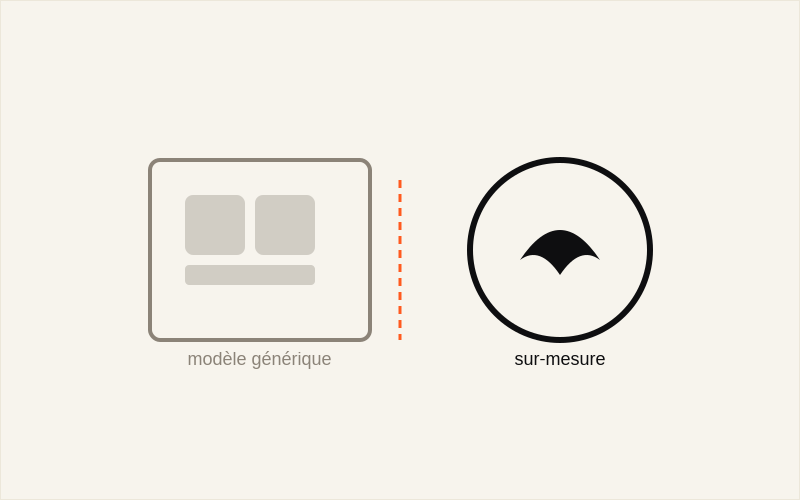
On immediate price, Canva wins without question: free or a few euros a month versus several hundred euros for a custom creation. But on exclusivity, depth of strategic thinking and quality of vector execution, the gap is just as clear in the other direction. The right comparison is therefore not "which is the better tool", but "which one matches the level of stakes in my current project".
A hidden-cost scenario to anticipate
The real financial risk of Canva for a logo isn't the cost of the tool, but the cost of replacing it later: once the logo is rolled out on many materials (website, cards, social media, packaging), any redesign means redoing all of those materials, not just the logo file itself.
To compare with a custom-drawn logo, see my logo design packages (from €290).
Frequently asked questions about Canva and the professional graphic designer
Can Canva be enough for a final logo?
It can be, for a very temporary or non-critical need, but the lack of a vector file and of exclusive templates makes it risky for an identity meant to last.
Why do professionals almost never use Canva to deliver a logo?
Because of the lack of precise vector control, the difficulty of handing over usable source files, and an originality limited by the shared template system.
Can you use Canva alongside a real custom logo?
Yes, it is an excellent use: producing secondary communication materials once the identity has been defined by a professional designer.
What is the real risk of starting with a Canva logo 'until something better comes along'?
The temporary logo often ends up circulating far longer than planned, and redoing it means redoing every material already in use, a much higher cost than expected.
A designer's perspective
I never demonise Canva as a tool: the problem is never the tool itself, but how it is used. Used for what it does well (quick communication materials), it is an excellent complement to real logo work.
The question is never 'is Canva good or bad', but 'is it the right tool for this specific level of stakes' — a logo meant to last for years doesn't have the same stakes as an Instagram post.
In summary
Canva is an excellent tool for everyday communication, but it shows its limits specifically for a logo meant to last and to work on every material.
The lack of an exclusive vector file and of built-in strategic thinking remains the tool's real weak point for this kind of creation.
Before choosing, ask yourself the real question: what is the real use of this logo, and for how long will it be used?