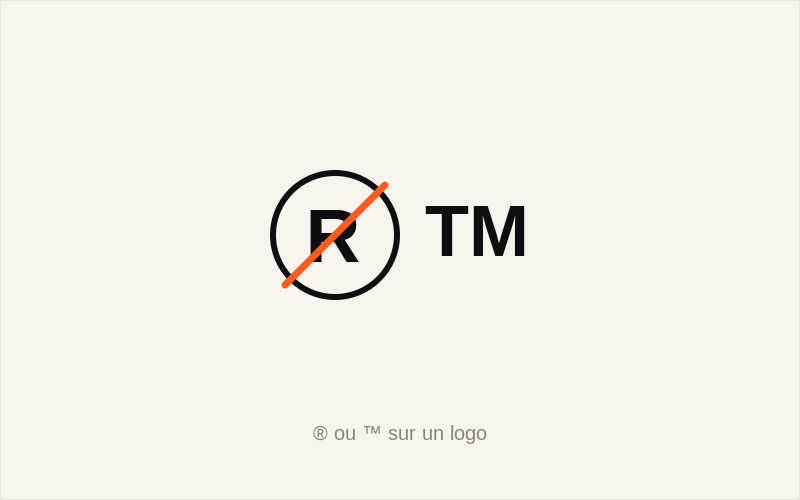
The short answer
Yes for ™, no for ®. ™ isn't governed by any particular rule in France: you can use it without registration. ® signals a trademark registered with an office, such as the INPI (the French trademark office) or the EUIPO (the EU trademark office). If that isn't the case, it gives false information to your customers and your competitors.
What each symbol means
- ™ (trademark). “I consider this sign to be my trademark.” It comes from Anglo-Saxon practice and proves nothing under French law.
- ® (registered). “This trademark is registered.” It is a statement that can be verified.
- © (copyright). It concerns copyright, not trademarks. In France, this right arises from the creation itself: the symbol is optional and adds no protection.
The risk of an unjustified ®
Specialist law firms link this case to misleading commercial practice (Article L. 121-2 of the French Consumer Code), which targets false indications or ones likely to mislead. Some also see a risk of unfair competition, since the symbol can deter a competitor by suggesting a right that doesn't exist.
The maximum penalties the Code sets for these practices are heavy: up to two years' imprisonment and a €300,000 fine (Article L. 132-2). Those are ceilings, not a price tag for a small symbol, and I haven't found a recent French ruling dealing precisely with a small trader's ®. But the maths is quick: registration costs €190 for one class and gives 10 years of protection, so the risk is not worth taking.
For a specific case, ask a lawyer: these general pointers are no substitute.
When should you switch to ®?
- Before filing: ™ if you want it, or nothing.
- After filing, before registration: stay with ™. An application can still face an opposition or a refusal.
- Once you have the registration certificate: ® becomes legitimate.
The rule is also territorial. A trademark registered in France doesn't necessarily justify an ® on materials aimed at a country where it isn't registered. If you export, check country by country, as some states are stricter than France on this point.
The symbol doesn't protect your logo
The misunderstanding is common. In France and the European Union, the symbol has no legal effect on protection: it informs and deters, nothing more. What counts is registration, in the right classes, after checking that the sign is available. If someone copies your logo, a ™ gives you no hold over them, whereas a registered trademark opens the way to an infringement action.
How to place them without spoiling your logo
This is the graphic side, the one the legal articles don't cover:
- Keep it out of the design. Place it at the top right or bottom right of the logo, without touching the letters.
- Keep it discreet. It should stay legible without becoming an element of the logo: check that it doesn't make the whole thing bigger.
- Remove it at small sizes. On a favicon or a profile picture, it becomes a blob. Plan a version without the symbol.
- Write the rule into your brand guidelines. A usage guide stops every printer from placing it their own way.
- Don't include it in the filing. Register the logo without the symbol: the protected sign must be your trademark, not the notice that goes with it.
Sources: TNJ Lex, Cleach Avocats, Mauriac law firm, Légifrance, Articles L. 132-1 et seq., INPI.
Frequently asked questions
Is ® mandatory after registering?
No. In France, no rule obliges you to display it. Your trademark remains protected without the symbol. It is a choice about communication and deterrence.
Can I use ® as soon as my application is sent to the INPI?
To be safe, wait for the registration certificate. Until the procedure is finished, the trademark is not yet registered, and ™ remains the more accurate choice.
Does ™ protect my logo?
No. It only signals that you consider this sign to be your trademark. It can have a deterrent effect, but it gives you no exclusive right.
Do you need to put © on a logo?
It isn't necessary: in France, copyright exists from the moment an original work is created, with no formalities. On a logo, © weighs down the design for very little benefit.
A designer's perspective
Graphically, I see these symbols as punctuation: useful when there is a reason for it, awkward when it is used to look important. A solid logo doesn't need an ® to look professional, and an ® has never saved a badly drawn logo.
Register first, display afterwards: in that order, the symbol tells the truth.
In summary
™ is free to use, ® is reserved for registered trademarks, and neither protects anything by itself.
If your logo matters to your business, the real subject is registration. The symbol comes last, discreetly, and comes off at small sizes.