Why it is hard to compare two logo prices
Between a free logo generated online and a brand identity billed at several thousand euros by an agency, the price gap can seem baffling. In reality, it reflects very real differences: level of experience, number of concepts proposed, depth of strategic thinking, and the scope of the deliverables. Comparing two quotes only on their total amount, without looking at what they include, is like comparing the price of a car without knowing whether fuel and options are included.
What really makes up the price of a logo
Five items explain most of the gap between a €290 service and one costing several thousand euros:
- Research and creative exploration time before arriving at the final proposals. This is often the longest and least visible part of the work.
- The number of concepts proposed and revisions included, which determine how many different directions are explored before sign-off.
- The formats delivered: a low-resolution simple PNG is nothing like a full package including vector files, variations and a usage guide.
- The transfer of usage rights, which guarantees you full ownership of your logo, a point often missing from the cheapest offers.
- The designer's experience, which reduces the risk of a logo that is generic, badly proportioned or hard to adapt to your materials.
A clear price, with no surprises, from the very first conversation?
See pricingA concrete breakdown: my 3 packages
To make this logic tangible, here is how I structure my own pricing, with what each tier really includes:
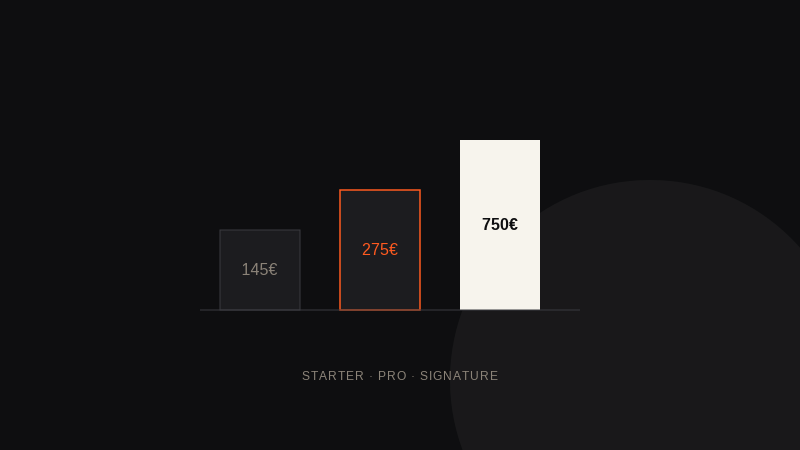
- Pro — €290: a lasting image, more directions explored at the start, and a usage guide to keep everything consistent across all your materials over time.
- Prestige — €525: a more complete brand, with deeper thinking about positioning and variations designed to support the growth of the business.
- Complete package — €1,150: a logo and full brand guidelines, for a brand that wants to lay solid foundations across all of its visual communication, not just its logo.
This tiered approach exists for a simple reason: an auto-entrepreneur (a French sole trader) who is just starting out and a company structuring its communication over several years have neither the same budget nor the same need. The price follows the real scope of the work, not the other way round.
The real cost of "cheap"
A cheap but poorly thought-out logo often costs more in the long run: it will have to be redone when the brand grows or, worse, it can harm the credibility of your business from the first contact with a potential client. The logo is often the first visual point of contact with your brand, so it is not the place to save at all costs. This hidden cost doesn't show on the initial invoice, but in the time and money spent later to fix or start over on an identity that was badly built from the start.
How to tell whether a quote matches your need
Before comparing figures, ask yourself a more useful question: what does this budget really have to cover for you? A one-off need with no strong commercial stakes doesn't justify the same investment as a brand meant to last several years across many materials. Once that need is clear, always ask for the details of a quote: number of concepts, revisions, formats delivered, transfer of rights. It is these details, far more than the headline amount, that tell you whether a price is justified.
What to check before signing a quote
Beyond the total amount, a few simple questions help you avoid nasty surprises once the project has started. Is the number of initial concepts specified, or does it stay vague? How many rounds of revisions are included, and what happens beyond that (extra charge, or the logo delivered as is)? Are the vector source files part of the delivery, or only a low-resolution export? Is the transfer of rights stated in black and white, or only implied? A clear quote answers these questions before you even ask them, which says a lot about the provider's seriousness.
One last point that is often overlooked: the stated turnaround. A logo delivered in 24 hours at a very low price rarely leaves room for a real research phase. That isn't necessarily a problem if the need is one-off and has no long-term stakes, but it isn't comparable to work carried out over several days with rounds of validation.
To see what these ranges look like in practice with me: logo design pricing (Pro, Prestige, Complete package), with what each package includes.
Frequently asked questions about the price of a professional logo
Why can two graphic designers charge very different prices for a seemingly similar logo?
Because research time, the number of concepts explored and the formats delivered vary enormously from one provider to another, even if the final result looks comparable at first glance.
Does the price of a logo always include usage rights?
No, and that is exactly one of the points to check every time before you sign: some very cheap offers don't clearly transfer the rights, which can cause problems if you want to register your trademark later.
Should you always go for the most complete package?
No, the right choice depends on your real situation. An entry-level package can be perfectly suitable for launching a business, as long as you are aware of what it includes and what it doesn't.
Can you change your package during the project if your needs change?
That is a question to ask the provider directly before you start: at Mow-Logo, it is possible to adjust or add to a service along the way, without starting from scratch, if the need turns out to be broader than expected.