Squid Game: the guard hierarchy, explained in detail
In Squid Game, the Korean Netflix phenomenon, hundreds of heavily indebted players take part in reworked children's games, with a single rule: elimination means death. Around them moves an army of fully masked guards in pink jumpsuits, totally anonymous, whose faces and names we never learn. Their only distinguishing sign: a geometric shape painted on their black mask, showing their exact rank in the island's hierarchy.
This system intrigued Squid Game viewers a great deal, to the point of generating huge numbers of searches about the exact meaning of each rank. Here is the breakdown of this hierarchy, as it appears in the series.
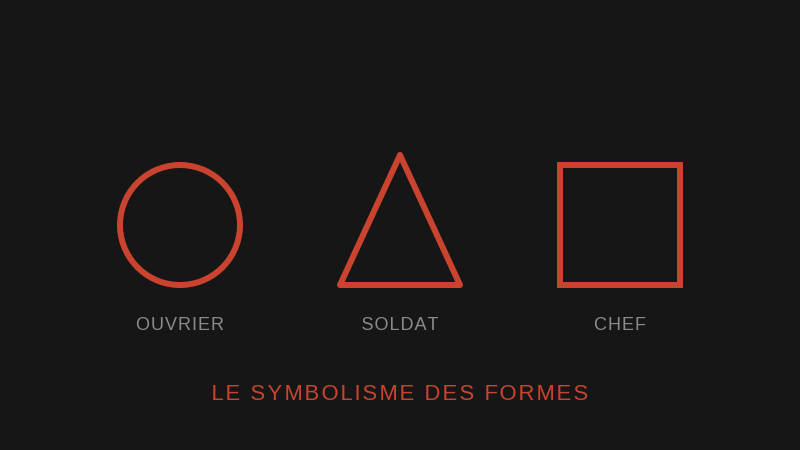
The circle: the workers of Squid Game
The guards marked with a circle hold the lowest rank in the Squid Game hierarchy. They are the workers: they handle the island's logistical and practical tasks — cleaning, carrying the bodies of eliminated players, maintaining the game facilities. They have no authority over the other guards and generally don't take a direct part in watching the players during the games.
The triangle: the soldiers of Squid Game
The guards marked with a triangle form the middle rank: they are the armed soldiers of Squid Game, the ones we see most often on screen. They watch the players during the games, enforce the rules by force if necessary, and carry out the orders passed down from the higher rank. Their role is directly operational: they are the ones who pull the trigger when a player breaks a rule.
The square: the leaders of Squid Game
The guards marked with a square hold the top of the masked guards' hierarchy: they are the managers and squad leaders. They oversee how the games run, give orders to the soldiers (triangles) and the workers (circles), and report directly to the island's supreme authority.
The Front Man: above the three ranks
Above this three-tier system stands a figure entirely apart in Squid Game: the Front Man, recognisable by his full black mask with no geometric shape. He runs the whole organisation of the games and answers himself to the VIPs who fund and watch the competition. His lack of a symbol underlines that he sits outside the ordinary hierarchy of the three shapes: he is neither circle, triangle nor square, but the authority that commands them all.
Why this system of shapes left such a mark
What made this system so memorable for Squid Game viewers is its immediate legibility: no need for dialogue or an explanatory subtitle, the shape alone instantly shows who has authority over whom. It's a visual system of formidable simplicity — and that is precisely what interests me as a graphic designer: this choice of shapes is probably no accident of the writing, but rests on the same principles as those used in visual identity and in the psychology of shapes.
The circle: the shape of the collective and the base
The circle naturally evokes continuity, equality and the absence of internal hierarchy: a shape with no angle and no precise direction, often associated with community and unity. Giving the circle to the lowest rank in the Squid Game hierarchy (the workers, all interchangeable, never individualised) fits this symbolism perfectly: a collective role, with no individual distinction or decision-making power.
The triangle: the shape of movement and action
The triangle, by contrast, is the most dynamic of the three: its angles and pointed tip suggest direction, tension and movement. That is exactly the role of the soldiers in Squid Game: active enforcers, constantly on the move, in charge of getting decisions applied through direct action. Here again the shape fits the function perfectly: the triangle is literally the shape that “points to” something, like an order to carry out.
The square: the shape of authority and structure
The square, the most stable and most “settled” of the three, naturally evokes solidity, order and control: it's a shape that doesn't move, that structures the space around it. Giving it to the managers and leaders of Squid Game reinforces their position of unmoving authority, at the top of a chain of command: they are the ones who decide, without having to move or act directly in the field.
What Squid Game confirms about the psychology of shapes
This example from popular fiction illustrates, almost like a public demonstration, a principle I apply concretely when creating logos: choosing a geometric shape is never neutral. The circle, the square and the triangle each convey a different feeling, regardless of any colour or typeface. I explain this principle in more detail, applied to a company's visual identity, in the psychology of shapes: circle, square or triangle for your brand.
What this means for your own logo
Beyond the Squid Game anecdote, the lesson is directly applicable: before choosing the basic shape of your logo, ask yourself what feeling it should trigger in your customer in a fraction of a second. Do you want to convey stability and authority (square), movement and energy (triangle), or unity and approachability (circle)? Even a mainstream fiction, with no stated educational intent, ends up confirming these principles almost instinctively: proof that they work, whatever the context in which they are observed.
Why this system works so well visually
Choosing simple geometric shapes (circle, triangle, square) allows the hierarchy to be read immediately, even from a distance or in the background of a scene. It's exactly the same principle that guides a good visual identity system: encoding complex information (a rank, a role, a function) in a simple shape recognisable in a fraction of a second.
A lesson in visual hierarchy that carries over to brand design
Beyond the series, this system illustrates a principle that applies to any brand identity that has to organise several levels or entities (a franchise, a network, product ranges): simple shapes or colours, applied consistently, can encode an entire hierarchy without needing complex explanations.
Frequently asked questions about the Squid Game guard hierarchy
What does the circle represent in the Squid Game hierarchy?
The circle marks the workers, the lowest rank in the hierarchy, in charge of the island's logistical and practical tasks.
What does the triangle represent in Squid Game?
The triangle marks the armed soldiers, the middle rank and the most visible on screen, in charge of watching the players and enforcing the rules.
What does the square represent in the guard hierarchy?
The square marks the squad leaders, at the top of the masked guards' hierarchy, who oversee the games and give the orders.
Why does the Front Man have no geometric shape on his mask?
Because he stands above this three-tier system: the absence of a symbol is precisely what marks his separate status, distinct from the guards' hierarchy.
A designer's perspective
What fascinates me about this Squid Game system is its radical simplicity: three basic geometric shapes are enough to organise a whole hierarchy, without a word or an extra colour. It's an effective reminder that visual clarity doesn't need complexity to be powerful.
The best visual systems aren't the most elaborate: they're the ones that convey the most information with the fewest possible elements.
In summary
The Squid Game guard hierarchy rests on a system of simple geometric shapes (circle, triangle, square), each encoding a precise rank in the organisation.
The Front Man stands out through the complete absence of a symbol, an elegant way of marking his separate status at the top of the structure.
This principle of simple, consistent visual coding can be carried over to any brand identity that has to organise several levels or entities.